Phase (post)1: (Open Space) Ever since I was a child I have always wanted to be an interior designer. I loved drawing, designing, dealing with design. That’s why I studied Graphic and Design in high school. I was thinking about studying at the department of Interior Architecture. (Blind Field) When I was in high school, when I asked my surroundings about my drawings, I was criticized that they were not very good. Most people said that I love traveling, and that it would be better for me not to go that way. (Secret Area) I realized that I didn’t like drawing much as I hid from people. That’s why I had to stop being an interior designer.
(Unknown Area) Then I couldn’t decide which profession was right for me. I couldn’t find the right choice. I wanted interior design, but my skills weren’t suitable for that. Since I like to travel, I read Tourism and Hotel Management.
”Herkes dünyayı değiştirme düşüncesinde fakat kendini değiştirmeyi düşünen kimse yok.” (Leo Tolstoy)
Many people enter our lives from an early age. We have an outward-looking personality, we pour our hearts as we do to our relatives. We remain introverted and remain a question mark for those around us. Today, in this article, we will look at the features that we open to others or that we have hidden in ourselves: the Johari Window.
Model The Johari Window bir, a model created by Joseph Luft and Harry Ingham in 1955, is used to understand how self-disclosure and feedback work together in the relationship. It is a helpful method of personal development in subjects such as self-knowledge, strengthening human relationships, and group dynamics.
As you can see in the figure, the window consists of 4 sections. Let us now consider the chapters separately.
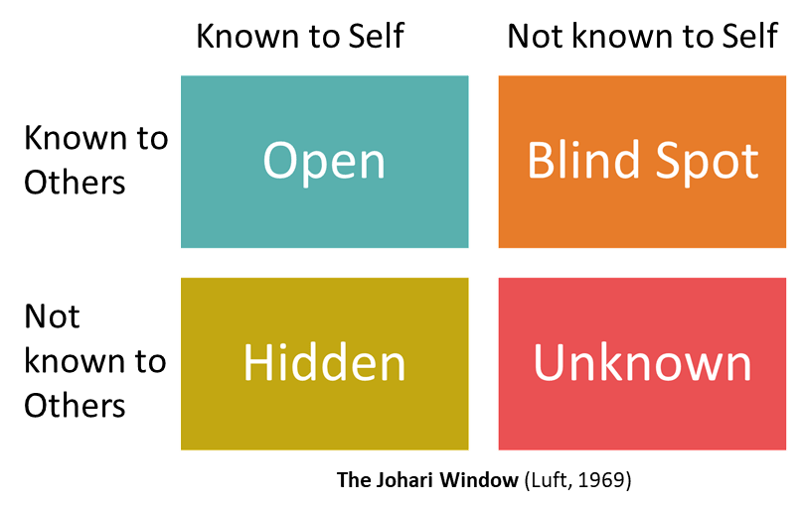
Open Space: It includes our features that we and other people are aware of. This area includes behaviors that we are not afraid to project out, which can be easily resolved by people. A large open space is the result of good and successful communication. Also, the ones with wide open space are self-confident, good human relations, sharing and natural people.
Secret Area: It consists of features that we know about ourselves but we do not want others to know. Fear, jealousy, anxiety, such as our feelings that are hidden in this section. Closed areas of sharing are wide open spaces of introverted people who camouflage themselves well. The feeling that we have a secret space reduces the trust of others. Therefore, reducing this area is important for the efficiency of our relations.
Blind Area: It is the section where the people around us know but which we are unaware of. For example, you may not know that you are talking while you sleep, but those who live with you know it. It is aimed to create self-awareness and reduce the blind area by getting feedback from people.
Unknown Area: An unknown area for everyone. Our undiscovered abilities may be included in this field. Questioning ourselves, interacting more with people play a role in shrinking this area.
By asking questions about the blind area around us; we can reduce the secret area by telling ourselves. Thus, we can increase our self-awareness and reach a higher quality dimension in human relations. Wishing you to solve yourself and lead a quality life…
”Birlikte yaşadığımız insalara karşı tutumumuz onları anlamamıza bağlıdır” ( Alfred Adler)
 GezGör''SıLa''